Many eruvin,  one goal
Launched by R’ Mayer & Chaya Rivka Fischl
The community's shmiras Shabbos depends in significant measure on the careful construction, layout, and maintenance of its eruvin. Iggud Eruvin of Lakewood coordinates a complex network of shechuna (neighborhood) eruvin bolstered by a unifying city eruv, so every street is serviced by the best possible, most reliable eruv.

The Challenge
Lakewood demands the highest standards in shmiras Shabbos and all areas of avodas Hashem. We have reasonable control over how an eruv is built, but little control over questions of reshus harabim and sechirus reshus. For decades, the poskim and roshei yeshiva who guide us have therefore discouraged the proliferation of eruvin across Lakewood. With good reason, Lakewood has been slower than other cities to embrace an inclusive eruv.
Today, one eruv or another covers 90–95% of Lakewood. The same commitment to shmiras Shabbos now requires us to work with the existing eruvin to uphold the highest standards possible.
The Mesorah


For decades, the communities of bnei Torah in Bnei Brak and Yerushalayim have worked toward the ideal eruv. Their model pairs a strong, reliable city eruv with a network of shechuna (neighborhood) eruvin.
Given its size, a city eruv will inevitably include certain streets or rely on structures that may be less than ideal. A shechuna eruv can be more selective, but its boundaries may be irregular. Someone unfamiliar with the exact boundary can easily carry beyond it, leading to inadvertent chillul Shabbos.
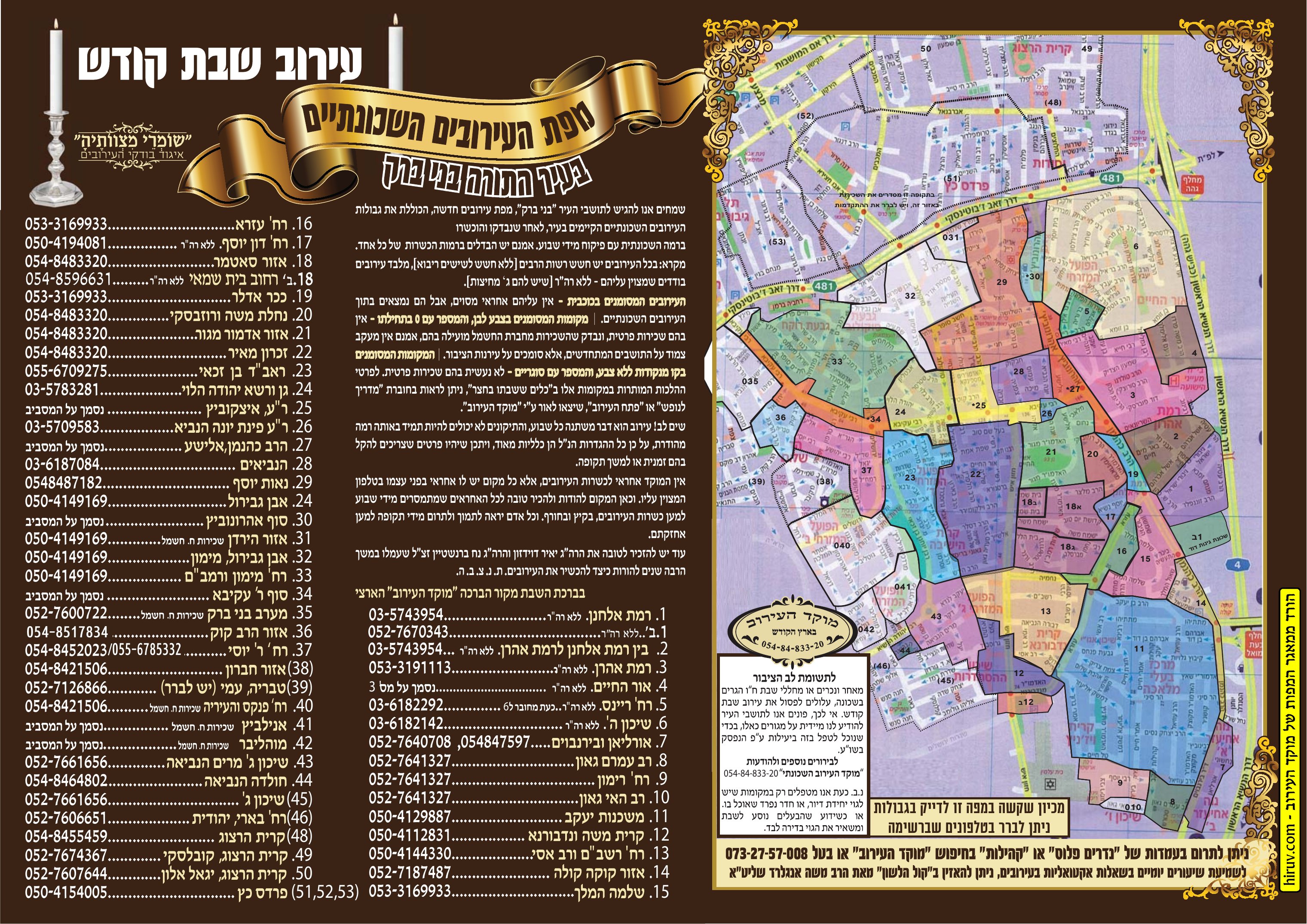
The Bnei Brak System
Bnei Brak has 53 shechuna eruvin. As the map shows, some have been more successful than others in excluding larger streets and achieving a higher standard of sechirus reshus.
All of Bnei Brak’s eruvin exclude Rechov Jabotinsky because, according to some opinions, it may qualify as masur l’shishim ribo (serving 600,000 people). To provide a crossing, the community invested millions in a bridge over the street.
Yerushalayim has a similar system, pairing its city eruv with a network of shechuna eruvin.
Under construction. The Lakewood City Eruv is currently under construction. It cannot and should not be relied on until it is completed. We will notify the tzibbur when that occurs.
The Lakewood Eruv Project
Following the models of Bnei Brak and Yerushalayim, Iggud Eruvin of Lakewood is working with the local eruvin, Lakewood’s roshei yeshiva, and the poskim. The shared goal is to coordinate the existing eruvin with an inclusive city eruv so that each street is served by the best eruv possible.
Those who seek a higher standard should remain mindful of the shechuna eruv boundaries when choosing where to carry. At the same time, someone who unknowingly carries beyond a shechuna eruv but remains within the city eruv will be protected from inadvertent chillul Shabbos.
The project will install hundreds of poles to enclose all areas that currently lack an eruv. It will also use poles to isolate certain areas of halachic concern, helping the shechuna eruvin meet the highest possible standard. Some shechuna eruvin will be redrawn to make their boundaries easier to recognize and follow.
This project is under the oversight of leading eruvin experts, with haskamos of the Roshei Yeshiva, Rabbonei and Poskei Ha’ir.
For our comprehensive halachic and procedure guidelines and the written haskamos mentioned above, email info@lakewooderuv.com.


Support the project
Building the Lakewood City Eruv means installing and maintaining hundreds of new poles, together with the coordinated network of shechuna eruvin. The estimated project cost is $1.5 million.
Every contribution helps bring a reliable eruv to every street in Lakewood. Questions? Email us.
Route 9 remains outside the eruv
In keeping with the mesorah from the Eretz Yisroel poskim guiding this approach, streets that have any chashash of shishim ribo are excluded even from the citywide eruv. Accordingly, Route 9 itself will remain outside the eruv.
The sidewalk of Route 9 will be both excluded by a clearly marked boundary and included by a second backup system.
Given the serious reshus harabim questions concerning Route 9, anyone who needs to carry on its sidewalks should consult a moreh hora’ah about their particular circumstances. Aside from the reshus harabim issues, the outer backup border may be irregular, leading to michsholim, and due to its proximity to heavy traffic, it is physically less reliable than the inner layers.